

Session closeout
End a Remote Session and Confirm It Is Closed
End the current viewer connection cleanly, verify remote control has stopped, keep the endpoint service running, and reconnect through a new authorized session when more work is required.
Production address
https://helpdesk.dsesecurity.com/
Confirm HTTPS and the exact domain before entering account or ticket information.
Visual walkthrough
Open any visual for a full-size reference
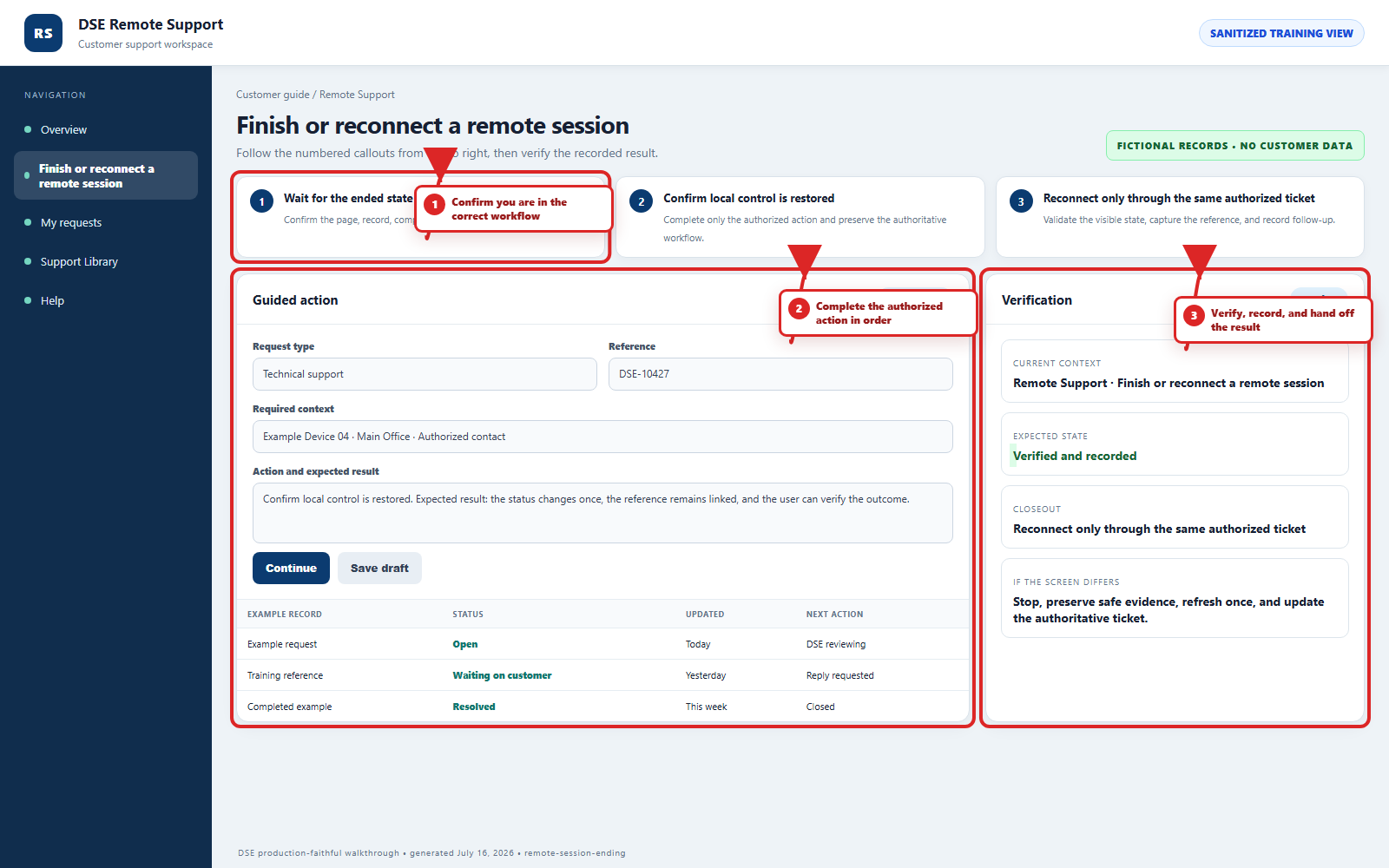
The annotated screenshot uses numbered red boxes and arrows. Read callouts 1, 2, and 3 in order, then return to the written steps below for the complete procedure.
 Open full size
 Open full size
 Open full size
1
Workflow section 1 of 6
Finish the support work
-
Complete a safe test of the original issue and tell the technician the result.
-
Save customer work and close any temporary windows opened for troubleshooting.
-
Confirm any restart, follow-up, remaining risk, or customer task before the session ends.
-
Ask the technician to end the remote session rather than only leaving the desktop idle.
2
Workflow section 2 of 6
End the current viewer connection
-
The technician selects the viewer End session control when the current support connection is complete.
-
Wait for the technician to confirm the session is closed.
-
Ending the viewer session stops that current remote-control connection; it does not stop or uninstall the DSE Endpoint Agent.
-
The background endpoint service and approved monitoring continue after the viewer session ends.
-
Ending a remote session does not normally require an agent reinstall or computer restart before a later authorized reconnect.
3
Workflow section 3 of 6
Confirm remote control has ended
-
Check that remote pointer or keyboard activity has stopped and any remote-session notice is gone.
-
Do not use the Machine Status protection state by itself to decide whether a viewer session is active; Machine Status reports endpoint status information.
-
Lock Windows when stepping away, even after the remote connection is closed.
-
Review the DSE ticket for the work completed, remaining action, and session closeout.
4
Workflow section 4 of 6
If activity appears to continue
-
Pause work and contact the technician on the existing DSE ticket or verified callback.
-
Do not share new credentials or approve additional prompts until DSE confirms the active session state.
-
If the activity is unexpected or cannot be verified, disconnect the device from the network only when your organization authorizes that security action.
-
Report the exact time, visible behavior, computer name, user, and any message without including secrets.
5
Workflow section 5 of 6
Reconnect only when needed
-
Use the same ticket when more work is required for the same issue.
-
A DSE technician can start or reconnect through a new authorized viewer session after the previous session has ended.
-
Confirm the technician, computer, scope, and new connection time before the new attended session.
-
Repeat the privacy preparation steps because a new session is a new support event.
-
After the final session, verify the result again and confirm the ticket has the correct closeout notes.
6
Workflow section 6 of 6
Finish and verify endpoint support
-
Confirm the endpoint status, remote-session state, and original symptom after the approved action.
-
Save customer work, have the technician select Clear secure relay after clipboard transfer, and lock Windows when stepping away.
-
Keep all follow-up on the same DSE-###### ticket for the same issue.
-
Report unexpected remote activity, missing tray status, or a failed validation immediately.
Final verification
Before you leave this guide
- Confirm context. Recheck the DSE domain, signed-in account, company or site, ticket number, device, and request type shown on screen.
- Confirm the result. Perform one harmless verification and make sure the visible status matches what you expected.
- Keep the reference. Save the DSE-###### ticket number, confirmation, or other safe reference needed to continue the same conversation.
- Stop on a mismatch. Do not repeat a high-impact action. Preserve a safe screenshot, note the time and exact error, refresh once, and update or open the correct DSE ticket.
Content owner: DSE Service Operations. Production reviewed July 16, 2026. Examples and visuals are customer-safe and use fictional data.